Never Pay Full Whack: The Black Country Nose for a Bargain That'd Make a Market Trader Weep
There's a particular look a Black Country person gets when they spot a price tag that's come down. Not excitement, exactly. More like quiet, professional satisfaction — the expression of someone who has confirmed what they already suspected: that patience pays, and that the asking price is always, always a suggestion.
This isn't about being skint. It's about being smart. And round here, the two have been confused for long enough that the region has quietly developed what might be the finest collective eye for a deal in the whole of Britain.
The Car Boot as Cathedral
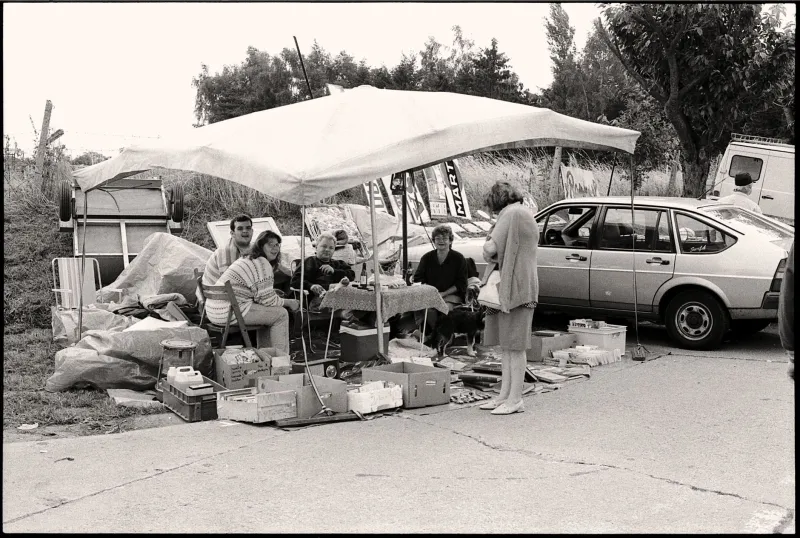
Ask any self-respecting Black Country bargain hunter where their church is, and there's a good chance it opens at six on a Sunday morning in a muddy field near Stourbridge.
Sandra, 58, from Tipton, has been attending the same car boot sale for twenty-three years. She brings a flask. She brings a torch in winter. She brings the focused energy of a woman who once paid fifty pence for a Royal Doulton figurine that sold on eBay for eighty-seven quid.
"You've gorr'a get there early," she says, wrapping her hands around her thermos. "The dealers come in before the gates even open. You've gorr'a move like you mean it."
Her technique is methodical: scan the table, don't touch anything yet, clock the seller's face, then pick up three items — two you don't want and one you do. Offer on all three together. Walk away if they say no. They'll call you back.
"They always call you back," she says with a smile that suggests she's never once had to break into a run.
The Market Stall Education
Black Country markets — Dudley, Brierley Hill, Halesowen — have been running masterclasses in commercial psychology for centuries. Long before anyone wrote a book about negotiation, the folk on those cobbles were doing it by instinct.
Dave, who's sold fruit and veg from the same spot in Dudley market for going on thirty years, reckons he can spot a serious buyer from twenty feet. "It ay the ones who come straight over and ask the price," he says. "It's the ones who walk past twice. They've already decided they want it. They're just working out how to ask without looking too keen."
This dance — the slow orbit, the casual question, the theatrical hesitation — is practically a regional art form. And the traders respect it. "If someone just pays what I ask without a word," Dave admits, "I almost feel bad for 'em."
Charity Shops and the Thrill of the Dig
The charity shops of the Black Country have been gentrified somewhat by the great national vintage revival, but seasoned hunters know that the good stuff still surfaces if you're willing to look properly.
Jordan, 24, from Wednesbury, started shopping in charity shops out of necessity during university. He came back to it as a hobby. "There's this rush when you find something," he says. "Like, genuinely better than buying something new. Because you found it. You worked for it."
He's particularly proud of a near-mint Barbour jacket he located behind a rail of shell suits in a Willenhall hospice shop. Four quid. He wears it everywhere.
"My nan always said: never buy owt full price if you can help it. I thought it were just 'cause they didn't have money. But it ay that, is it? It's a whole way of thinking."
He's right. It is a whole way of thinking.
The Psychology of Never Blinking First
Dr. Rachel Moss, a consumer behaviour researcher at the University of Wolverhampton, has a theory about why bargain-hunting runs so deep in Black Country culture. "There's a historical context here that matters," she says. "When wages were low and work was physically brutal, every penny genuinely counted. The skills that came from that — patience, shrewdness, an instinct for fair value — they get passed down. They become cultural DNA."
She also points out that there's a social dimension people miss. "Negotiating a price is a form of social interaction. It requires reading people, building brief rapport, knowing when to push and when to leave it. Those are sophisticated skills. They just don't get recognised because they happen at a car boot sale rather than in a boardroom."
Tell that to Sandra, who's just talked a man down from three pounds to a pound fifty on a Le Creuset dish and is already heading for the next table.
High Street Hacks and the Long Game
The bargain instinct doesn't stop at the car boot gate, either. Black Country shoppers have long since cracked the rhythms of the high street — the post-Christmas slaughter, the end-of-season clearances, the quiet markdown that happens on a Wednesday afternoon when the manager wants to shift stock before the lorry comes Thursday.
Kev, 41, from Cradley Heath, has bought every major appliance in his house at a discount. Not through voucher codes or cashback apps — through old-fashioned timing and nerve. "I waited eight weeks to buy a washing machine," he says without a flicker of embarrassment. "I knew it were going into the sale. I had a camping trip booked and I just used the laundrette."
His partner Tracey chips in: "He's the same with petrol. He knows every garage and their price cycle."
Kev shrugs. "It ay obsessive. It's just paying attention."
The Thing Nobody Talks About
Here's what the lifestyle magazines and the financial influencers with their colour-coded spreadsheets always miss: in the Black Country, hunting a bargain has never been shameful. There's no performance of reluctance, no apologetic cough before admitting you got something cheap.
Quite the opposite. Coming home with a brilliant find and telling the story of how you got it — the circling, the offer, the counter-offer, the walk-away, the call-back — that's entertainment. That's something to tell people. You don't whisper it. You crow about it.
Because round here, knowing the value of things has always been a virtue. Not a compromise. Not a sign of hardship. A skill. A proper one. The kind that gets handed down at kitchen tables and on market mornings and in muddy fields at six o'clock on a Sunday.
Full whack? Not if you can help it, bab.