Last Orders? Not Bloody Likely: The Black Country Local Is Alive, Bostin', and Refusing to Budge
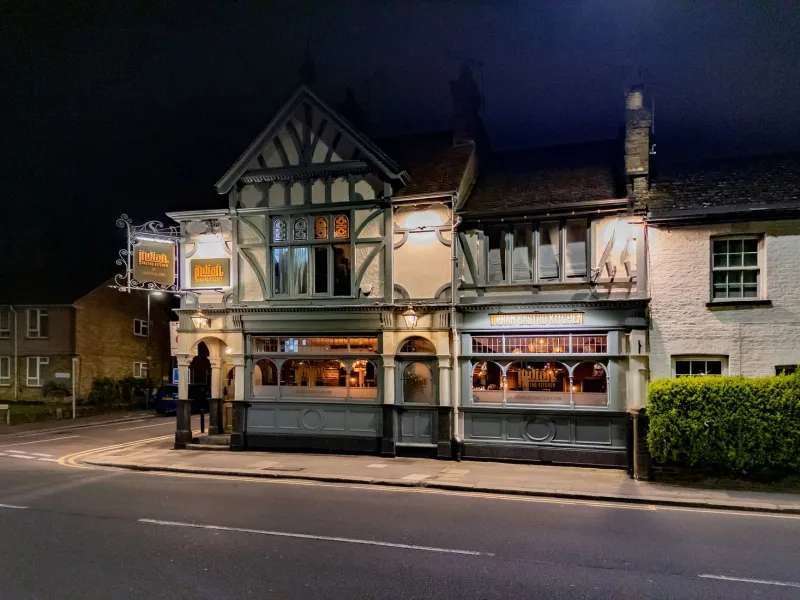
I'll tell yo' exactly when I knew the Black Country pub was immortal. It was a Tuesday afternoon — a Tuesday, mind — in a boozer in Coseley that had carpet the colour of a mild hangover and a fruit machine that hadn't paid out since the second Jubilee. There were six people in the place. One was asleep. Another was engaged in what appeared to be a deeply serious argument with the barmaid about whether Alan Shearer was overrated (he was, she insisted, and she wasn't for shifting).
And yet — and yet — there was something in that room that no trendy bar in Shoreditch, no rooftop cocktail lounge in Manchester, and no exposed-brick craft ale emporium in Birmingham could replicate. There was a warmth. A belonging. A sense that this particular corner of the world had been here a long time and wasn't going anywhere in a hurry.
That's the Black Country local. And it's one of the most underrated cultural institutions in Britain.
More Than a Pint: The Pub as Parish Hall
Let's be clear about what we'm actually talking about here, because it ay about the beer — though the beer is often excellent, and a proper pint of Banks's on a cold January afternoon is one of life's genuinely transcendent experiences. No, what makes the Black Country local extraordinary is its function.
For generations, these pubs have served as the informal community infrastructure of working-class life. Before the welfare state, before community centres, before Facebook groups, the local was where yo' found out who needed help, who had work going, whose wife had just had a babby, and whose husband had just done a runner. It was the exchange, the noticeboard, the counselling service, and the social club all rolled into one.
"My nan used to say the pub was where the neighbourhood breathed," recalls Sandra Whitehouse, 58, a lifelong Tipton resident whose family has drunk in the same establishment across four generations. "Not because everybody was drunk — well, not always — but because it was where yo' went to be part of summat. Yo' knew everybody's name. Yo' knew everybody's business. And when things went wrong for somebody, the pub was where the community organised itself to help."
That function hasn't entirely disappeared. Walk into the right Black Country local on the right night and yo'll still find it — the collection tin for somebody's funeral costs, the raffle for the local kids' football team, the landlord who quietly lets a struggling regular run a tab because he knows they'm good for it eventually.
The Dialect Lives in the Snug
Here's a linguistic observation that any Black Country gob will confirm: the dialect is at its most alive, most vivid, and most gloriously unself-conscious in a pub. Not in a television studio, not in a heritage centre, not in a carefully curated social media video. In a pub, on a Friday night, when the second pint has gone down and the conversation is flowing.
That's where yo' hear the full flowering of it. The "yampy" and the "bostin'" and the "ay it" and the "bab." The vowels that stretch and compress in ways that confound outsiders and delight linguists. The particular Black Country habit of packing enormous emotional nuance into extremely short sentences. ("Ar." Said correctly, with the right intonation, can mean anything from "yes, I agree" to "I profoundly understand your suffering.")
"Pubs are dialect incubators," says Professor Clive Upton, a sociolinguist who has studied regional speech across the Midlands. "Formal environments — schools, workplaces, media — create pressure to standardise. Informal social spaces, especially ones with strong community identity, allow dialect to persist and evolve naturally. The Black Country pub is doing more for the survival of that dialect than any academic programme."
Which is a very professorial way of saying: if yo' want to hear proper Black Country, get theeself to a proper Black Country boozer.
The Gastropub Menace and the Resistance
Now, it would be dishonest not to acknowledge the threat. Pub closures across Britain have been catastrophic over the past two decades — around 13,000 have shut since 2000, according to the Campaign for Real Ale — and the Black Country hasn't been immune. Developers have circled. Chains have moved in with their laminated menus and their "artisanal" this and their "curated" that.
And look, we'm not entirely opposed to a decent burger or a nice bit of halloumi. We'm not monsters. But there's a particular kind of horror in watching a beloved local get stripped out, refitted with reclaimed wood and Edison bulbs, and reopened at three times the price with a cocktail menu and no regulars. That's not a pub anymore. That's a pub-shaped object.
"They did it to the one on our road," says Terry Bagnall, 67, a retired toolmaker from Willenhall who has been drinking in Black Country pubs for fifty years. "Lovely old place, it was. Sticky carpet, brilliant landlord, darts team that'd been going since 1987. Then some developer bought it, spent a fortune on it, and now it's full of people on laptops. I doh begrudge 'em their lattes, bab. But it ay my pub no more, is it?"
The resistance, though, is real and it's scrappy and it's very Black Country. Community buy-outs. Listings as assets of community value. Locals who simply refuse to go anywhere else and make enough noise about it that the developers think twice. There's something almost defiant about a community that decides, collectively, that this particular building matters and we'm keeping it.
Why Loyalty to Place Is a Radical Act
In an age that prizes mobility, flexibility, and the willingness to uproot yourself for a better job or a cheaper flat or a fresh start, there's something almost countercultural about the Black Country attachment to place. To the street you grew up on. To the pub your dad drank in. To the accent that gives you away the moment you open your mouth, and the quiet pride you feel when it does.
It's not insularity. It's not small-mindedness. It's something much more interesting than that — a conscious, sometimes fierce decision that rootedness has value. That community is worth maintaining. That the people yo' grew up with, the places that shaped yo', the dialect that expresses what standard English can't quite manage — these things are worth protecting.
The Black Country local, at its best, is the physical embodiment of that decision. It's a place where class solidarity, cultural identity, and genuine human connection survive in the same room, every night of the week, over a pint of something decent.
So no, we ay calling last orders on any of that. Not today. Not ever.
Get 'em in, bab.